

D2 vs D3 Steel: Key Differences, Uses, and Which One to Choose
When it comes to industrial tools, manufacturing, and heavy-duty applications, choosing the right steel grade plays a crucial role in performance and durability. Among the most widely used tool steels are D2 and D3 steel grades. Both belong to the high carbon, high chromium tool steel category, yet they differ significantly in composition, properties, and applications.
In this detailed guide, we will explore the differences between D2 and D3 steel, their properties, uses, advantages, and how to choose the right one for your needs.
What is D2 Steel?
D2 steel is a high carbon, high chromium air-hardening tool steel known for its excellent wear resistance and toughness. It contains around 1.5% carbon and 12% chromium, making it semi-stainless with good corrosion resistance compared to other tool steels.
Key Features of D2 Steel:
- High wear resistance
- Good toughness
- Moderate corrosion resistance
- Excellent dimensional stability after heat treatment
- Long tool life
Because of its balanced combination of hardness and toughness, D2 steel is widely used in applications where both durability and resistance to wear are required.
What is D3 Steel?
D3 steel is another high carbon, high chromium tool steel, but it has a higher carbon content (around 2.0%) compared to D2. This makes D3 extremely hard and wear-resistant but also more brittle.
Key Features of D3 Steel:
- Extremely high wear resistance
- Higher hardness than D2
- Low toughness
- Poor weldability
- Minimal distortion during heat treatment
D3 is often used in applications where abrasion resistance is more important than impact resistance.
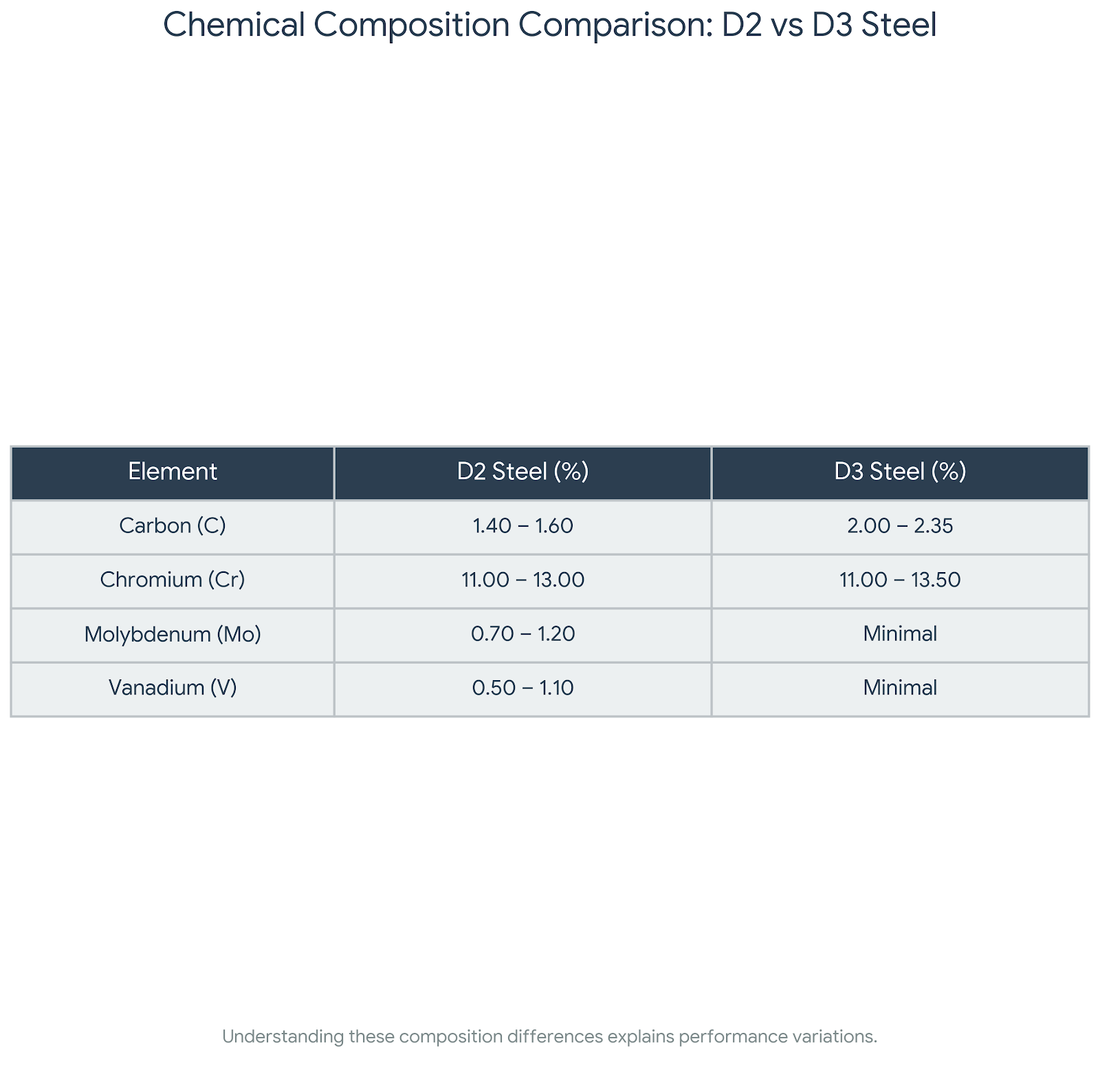
Chemical Composition Comparison
Understanding the chemical composition helps explain the differences between D2 and D3.
Key Insight:
- D3 has higher carbon, making it harder but more brittle
- D2 contains molybdenum and vanadium, improving toughness and wear resistance balance
D2 vs D3: Key Differences
1. Hardness
D3 steel is harder than D2 due to its higher carbon content. It can achieve higher hardness levels after heat treatment.
- D3 Steel: Higher hardness
- D2 Steel: Slightly lower but more balanced
👉 If maximum hardness is required, D3 is the better choice.
2. Toughness
Toughness refers to the ability to absorb impact without breaking.
- D2 Steel: Better toughness
- D3 Steel: More brittle
👉 D2 is preferred for applications involving shock or impact.
3. Wear Resistance
Both steels offer excellent wear resistance, but:
- D3 Steel: Superior wear resistance
- D2 Steel: Very good but slightly lower
👉 For abrasive environments, D3 performs better.
4. Machinability
Machinability is easier in D2 compared to D3.
- D2 Steel: Easier to machine
- D3 Steel: Difficult due to high hardness
👉 If machining complexity is a concern, go with D2.
5. Heat Treatment
Both steels are air-hardening, but:
- D2 Steel: Better dimensional stability
- D3 Steel: Slightly more brittle after hardening
6. Corrosion Resistance
Neither is fully stainless, but:
- D2 Steel: Better corrosion resistance
- D3 Steel: Slightly lower resistance
Applications of D2 Steel
D2 steel is widely used across industries due to its versatility.
Common Uses:
- Cutting tools
- Dies and punches
- Shear blades
- Thread rolling dies
- Woodworking tools
- Plastic moulds
Its toughness makes it suitable for tools that experience repeated stress and impact.
Applications of D3 Steel
D3 steel is ideal for applications requiring extreme wear resistance.
Common Uses:
- Blankings dies
- Cold work tools
- Scrap cutters
- Industrial knives
- Forming rolls
Because of its brittleness, it is not suitable for high-impact environments.
Advantages of D2 Steel
- Balanced hardness and toughness
- Longer tool life in dynamic applications
- Better machinability
- Lower risk of cracking
- Suitable for complex tool designs
Advantages of D3 Steel
- Exceptional wear resistance
- Higher hardness levels
- Ideal for abrasive conditions
- Minimal wear over time
Limitations of D2 and D3 Steel
D2 Steel Limitations:
- Not fully corrosion-resistant
- Slightly lower hardness than D3
D3 Steel Limitations:
- Brittle in nature
- Difficult to machine
- Not suitable for impact-heavy applications
D2 vs D3: Which One Should You Choose?
Choosing between D2 and D3 depends on your application requirements.
Choose D2 Steel if:
- You need better toughness
- Your tools face impact or stress
- You want easier machining
- You need longer tool life in dynamic conditions
Choose D3 Steel if:
- You need maximum hardness
- Your application involves high abrasion
- Impact is minimal
- Wear resistance is your top priority
Industrial Perspective: Why the Right Grade Matters
In industries like automotive, manufacturing, and construction, selecting the wrong steel grade can lead to:
- Frequent tool failure
- Increased maintenance cost
- Reduced productivity
By choosing the right material like D2 or D3, businesses can improve efficiency, reduce downtime, and increase overall profitability.
Tips for Selecting the Right Tool Steel
Here are some practical tips to help you decide:
- Analyze Application Type
Determine whether your tool will face impact, abrasion, or both. - Consider Cost vs Performance
Higher hardness doesn’t always mean better performance. - Evaluate Machining Needs
Complex designs require machinable materials like D2. - Check Heat Treatment Capability
Proper heat treatment is crucial for performance.
Why Choose Iron SS Enterprise?
At Iron SS Enterprise, we specialize in supplying high-quality tool steels, including D2 and D3 grades, tailored to meet industrial requirements. Our commitment to quality, precision, and customer satisfaction ensures you get the right material for your application.
What Sets Us Apart:
- Premium quality steel products
- Reliable sourcing and supply
- Competitive pricing
- Expert guidance for material selection
Conclusion
Both D2 and D3 steels are excellent choices for tool-making and industrial applications, but they serve different purposes. While D2 offers a balanced combination of toughness and wear resistance, D3 excels in hardness and abrasion resistance.
Understanding these differences is essential to making the right decision for your business. By selecting the appropriate grade, you can significantly improve tool performance, reduce costs, and enhance productivity.
FAQs: D2 vs D3 Steel
1. Is D2 steel better than D3?
Not necessarily. D2 is better for toughness, while D3 is better for wear resistance.
2. Which steel is harder, D2 or D3?
D3 steel is harder due to higher carbon content.
3. Can D3 steel be used for high-impact tools?
No, D3 is brittle and not suitable for high-impact applications.
4. Is D2 steel corrosion-resistant?
D2 offers moderate corrosion resistance but is not fully stainless.
5. Which steel is easier to machine?
D2 steel is easier to machine compared to D3.