

Steel is the backbone of modern industry, powering everything from construction and automotive manufacturing to heavy machinery and tools.
However, choosing the right type of steel can significantly impact performance, durability, and cost-efficiency.
Among the most widely used materials are alloy steel and carbon steel. While both share a common base of iron and carbon, their properties and applications differ greatly. Understanding these differences is crucial for selecting the right material for your specific industry needs.
In this detailed guide, we will explore alloy steel vs carbon steel, their properties, advantages, disadvantages, and how to choose the best option for your business.
What is Alloy Steel?
Alloy steel is a type of steel that contains additional elements such as chromium, nickel, molybdenum, or vanadium. These elements are added intentionally to enhance specific properties like strength, toughness, corrosion resistance, and heat resistance.
Key Features of Alloy Steel:
- High strength and durability
- Excellent corrosion and oxidation resistance
- Superior performance in extreme temperatures
- Enhanced wear resistance
- Customizable properties for specialized applications
Common Types of Alloy Steel:
- Low-alloy steel
- High-alloy steel
- Stainless steel
- Tool steel
Alloy steel is widely used in industries that demand high performance and reliability, such as aerospace, automotive, oil & gas, and power generation.
What is Carbon Steel?
Carbon steel primarily consists of iron and carbon, with very minimal alloying elements. Its properties are largely determined by the amount of carbon present in the material.
Types of Carbon Steel:
- Low Carbon Steel (Mild Steel)
- Soft, ductile, and easy to weld
- Medium Carbon Steel
- Balanced strength and machinability
- High Carbon Steel
- Extremely hard but less ductile
Key Features of Carbon Steel:
- High strength (depending on carbon content)
- Cost-effective and widely available
- Easy to machine and weld
- Lower corrosion resistance
Carbon steel is commonly used in construction, pipelines, automotive frames, and general engineering applications.
Alloy Steel vs Carbon Steel: Key Differences
1. Composition
The primary difference lies in their chemical makeup.
- Alloy Steel: Contains additional elements like chromium, nickel, and molybdenum
- Carbon Steel: Mainly iron and carbon with minimal additives
These alloying elements allow alloy steel to be engineered for specific applications, making it more versatile.
2. Strength and Hardness
Alloy steel generally offers higher strength and toughness due to the presence of alloying elements.
Carbon steel can also achieve high strength by increasing carbon content, but this often reduces ductility and increases brittleness.
 Verdict: Alloy steel is better for high-stress and heavy-load applications.
3. Corrosion Resistance
One of the biggest advantages of alloy steel is its excellent corrosion resistance, especially when elements like chromium are added.
Carbon steel, on the other hand, is prone to rust and requires protective coatings.
Verdict: Alloy steel is ideal for harsh environments.
4. Durability and Wear Resistance
Alloy steel contains elements that form hard carbides, improving wear resistance and lifespan.
Carbon steel tends to wear out faster in demanding conditions.
Verdict: Alloy steel offers longer service life.
5. Machinability and Weldability
Carbon steel is easier to machine and weld, especially low-carbon grades.
Alloy steel may require special tools and techniques due to its hardness.
Verdict: Carbon steel is better for fabrication ease.
6. Cost Comparison
- Alloy Steel: More expensive due to added elements and processing
- Carbon Steel: Affordable and cost-effective
Verdict: Carbon steel is ideal for budget-sensitive projects.
Industrial Applications: Where Each Steel Excels
 Applications of Alloy Steel
Alloy steel is preferred in industries where performance is critical:
- Aerospace components
- Automotive parts (gears, shafts, axles)
- Power plants and turbines
- Oil & gas pipelines
- Heavy-duty machinery
Its ability to withstand extreme conditions makes it indispensable for high-performance engineering.
 Applications of Carbon Steel
Carbon steel is widely used in:
- Construction (beams, structures)
- Bridges and infrastructure
- Automotive frames
- Pipes and tubes
- General fabrication
Its affordability and ease of use make it the go-to material for mass production.
Advantages and Disadvantages
 Advantages of Alloy Steel
- Superior strength and toughness
- High resistance to corrosion and heat
- Longer lifespan
- Suitable for specialized applications
 Disadvantages of Alloy Steel
- Higher cost
- Complex machining and welding
- Requires skilled handling
Advantages of Carbon Steel
- Cost-effective
- Easy to machine and weld
- Widely available
- Good strength for general applications
Disadvantages of Carbon Steel
- Prone to corrosion
- Lower durability in harsh environments
- Limited performance under extreme conditions
Which is Better for Your Industry?
The answer depends on your specific requirements. There is no one-size-fits-all solution.
Choose Alloy Steel if:
- You need high strength and durability
- Your application involves extreme temperatures or pressure
- Corrosion resistance is critical
- Long-term performance is more important than cost
Choose Carbon Steel if:
- You want a budget-friendly solution
- The application is general-purpose
- Ease of fabrication is important
- Environmental conditions are not harsh
In simple terms:
- Alloy steel = Performance & durability
- Carbon steel = Cost & versatility
Industry-Based Recommendation
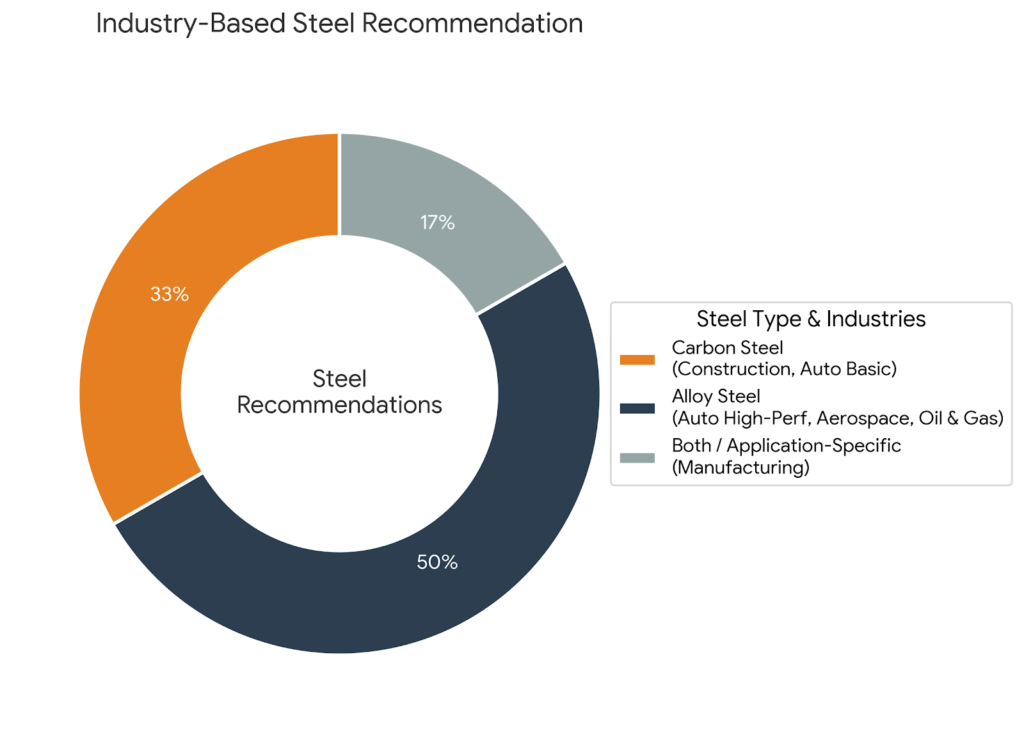
Future Trends in Steel Selection
With advancements in metallurgy, alloy steels are becoming more efficient and cost-effective. At the same time, carbon steel continues to dominate due to its affordability and versatility.
Industries are increasingly shifting toward hybrid solutions, combining the strengths of both materials for optimized performance.
Conclusion
Both alloy steel and carbon steel play a vital role in modern industries. While they share similarities, their differences in composition, strength, corrosion resistance, and cost make them suitable for different applications.
- Alloy steel is the best choice for demanding, high-performance environments.
- Carbon steel remains the preferred option for cost-effective and general-purpose use.
Ultimately, the right choice depends on your industry needs, budget, and performance expectations.
FAQs
1. Which is stronger: alloy steel or carbon steel?
Alloy steel is generally stronger due to the presence of alloying elements that enhance its mechanical properties.
2. Is alloy steel more expensive than carbon steel?
Yes, alloy steel is more expensive because of additional elements and processing.
3. Which steel is better for construction?
Carbon steel is commonly used in construction due to its affordability and ease of use.
4. Does carbon steel rust easily?
Yes, carbon steel is prone to rust and requires coatings or maintenance.
5. Can alloy steel be welded?
Yes, but it may require special techniques and equipment